
Assembly Insights: The Wider Legacy of Remembrance
Assembly Extract from Mr Alex Frazer, Head
Presented on Monday 10 November 2025
Yesterday some members of the school community, including several Old Bancroftians, attended a highly moving Service for Remembrance Sunday here at school - in the Great Hall and on the Quad – to which the CCF and Scouts made a significant contribution, as did many of you who sing.
Tomorrow we will all go outside at the end of Period 2, as we did a year ago, to perform with due solemnity our whole-school Act of Remembrance. Tomorrow is 11 November which is commemorated as the anniversary of the day in 1918 on which the First World War came to an end – with the armistice taking effect at the eleventh hour of the eleventh day of the eleventh month.
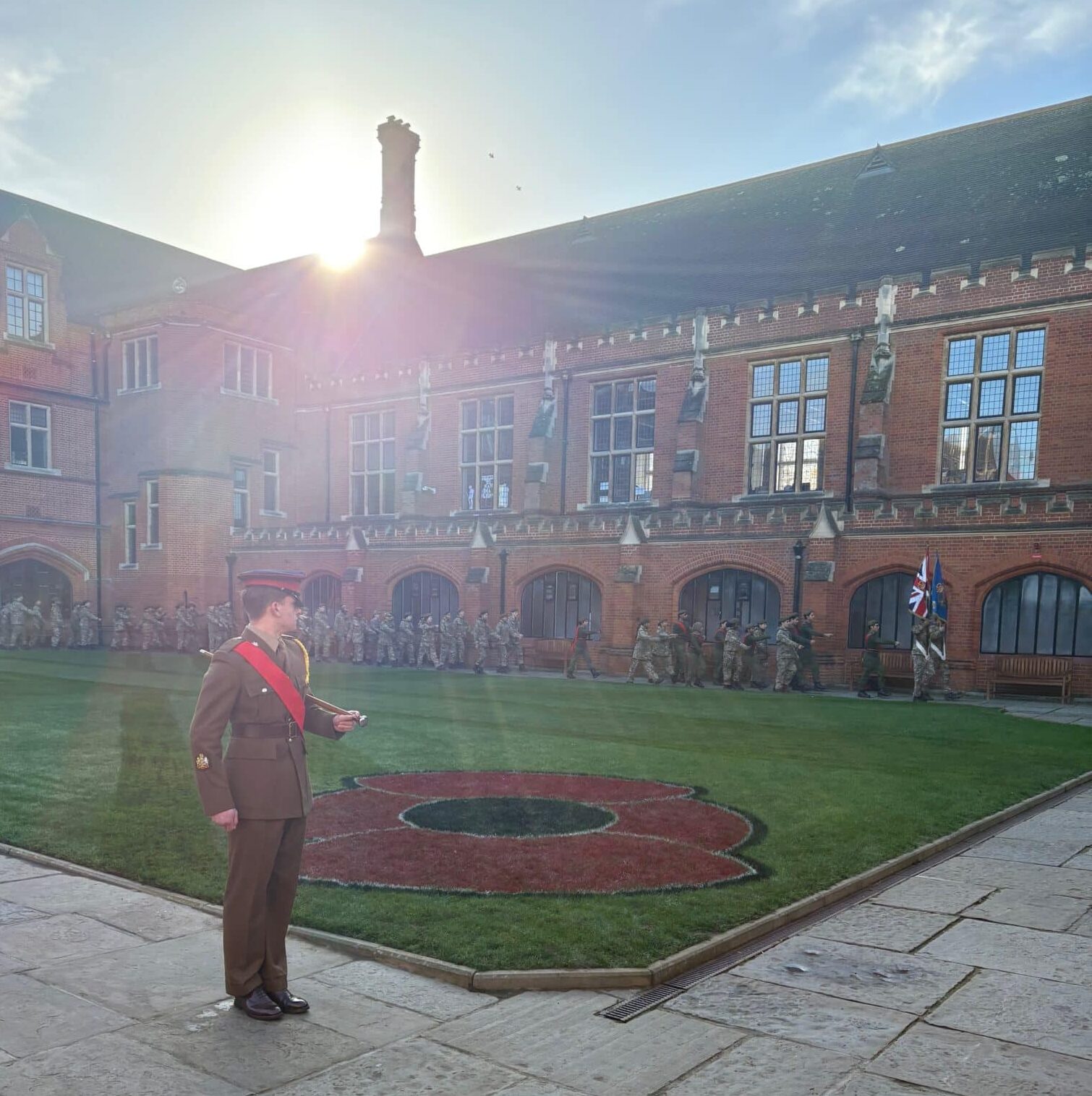
Though Remembrance as an annual, national act to show respect for the fallen began as we know it in the wake of the First World War, its meaning has since been expanded to include all those who have lost their lives in other wars and conflicts since. If you’re new to Bancroft’s, you may not yet have noticed that the boards in the corridor leading to my office, and the gates out of the front of school, memorialise the names of Old Bancroftians – chiefly young men only a few years older than you – who perished in the First and Second World Wars respectively.
Wars continue in the 21st Century and very sadly in that corridor you will also find the names – and you will hear their names tomorrow – of two former pupils of our school who died on British Army service in Afghanistan, both in 2011: Lt Dan Clack and Lance-Corporal Paul Watkins. Lt Clack is also remembered at Bancroft’s through a CCF trophy named after him – it’s a very smart bugle which you can see in a display cabinet outside the Chaplain’s office – and also through the CCF Regimental Sergeant Major’s cane, visible in another cabinet nearby, which was presented to the School by Lt Clack’s mother.
The sacrifices made by Dan Clack, Paul Watkins and all the other Old Bancroftians whose names we know are worthy of our ultimate respect and consideration, of course, and we will think of them tomorrow. But today I would like to shift our focus to other 20th Century servicemen who would not have attended Bancroft’s or anywhere like it, for reasons that will become clear.
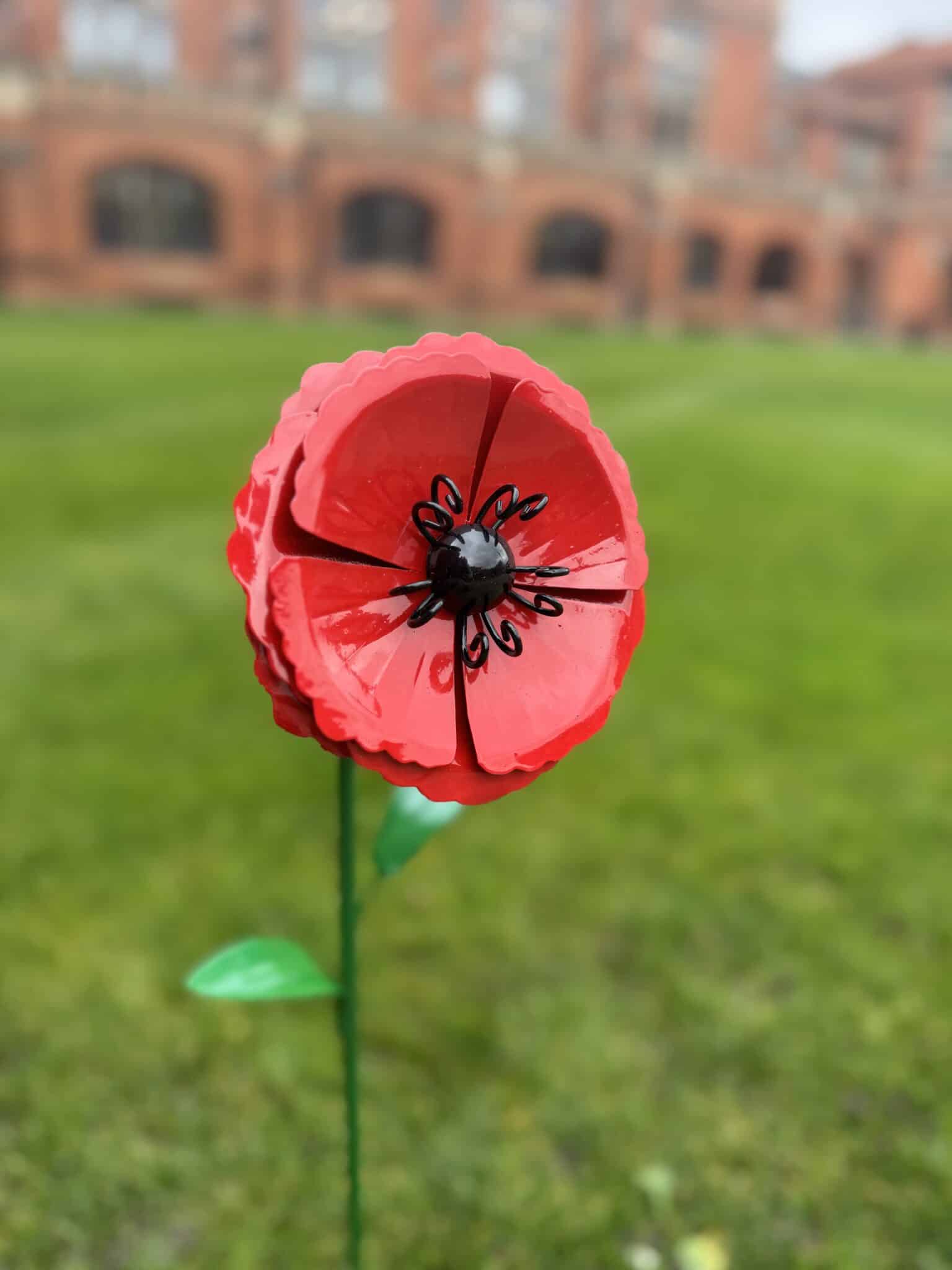
Some time ago I was, for a few years, the Head of Wolverhampton Grammar School in Wolverhampton in the West Midlands, about half an hour’s drive north-west of Birmingham. WGS is similar to Bancroft’s in many ways – an independent school for boys and girls, though formerly a boys’ school, occupying Victorian red brick buildings on a main road in a residential area. WGS has a proudly diverse pupil body in a manner similar to Bancroft’s, with around 65% coming from a South Asian background – many of whom in the case of WGS are Sikhs, as Wolverhampton and its surroundings are a major centre for the British Sikh community.
Like Bancroft’s, WGS has a large number of impressive and inspiring former pupils. One in particular whom I got to know during my time there was the journalist and author Sathnam Sanghera. You or your parents may have read his articles in The Times newspaper, followed him online or watched his occasional forays onto the television. He is a thought-provoking commentator on many matters of public life, politics, society, culture and history and is well worth checking out if you have not heard of him.
Sathnam Sanghera comes from Wolverhampton’s Sikh community and in fact could not speak English until he started at primary school. He went on to attend WGS on a full scholarship and he excelled academically, going to Cambridge in 1995 to study English Literature. In my experience, Sathnam has always spoken warmly about his schooldays but also with justified criticism about what he was not taught there – which was a consequence of prevailing norms in education at the time as well as because of the decisions taken at WGS. In particular, and he has written about this in an excellent book called Empireland, he has asked questions about why British children do not learn more, and in more nuanced and subtle ways, about the British Empire – its achievements, its crimes and injustices and its enduring legacy.
Sathnam came back to WGS to make part of a television series based on his book, and for this he interviewed a group of Sixth Formers about what they had learned about Empire at school. He concluded that things had moved on quite well since his schooldays, when he had not had a single History lesson covering any aspect of Empire, but there was clearly still room for improvement both generally and at his old school. At Bancroft’s we have been on a similar journey, especially in the first three years of the curriculum. Mr Brennand, the Head of History, tells me that the History Department used to teach a lot about the Industrial Revolution in Britain, but has moved to cover much more about the origins of Empire and Britain’s imperial activities in India.
Notwithstanding the progress made, Sathnam feels strongly that a particular area to improve is our national understanding of the contribution of troops from around the British Empire, and the losses they suffered, in the First and Second World Wars. A few years ago he addressed the pupils and staff of WGS in a Remembrance Assembly in a bid to put this right where he could, and I shall now try to build upon the lessons he shared on that occasion.
We tend to think of the First World War as a war fought by Europeans against other Europeans – and in the theatres of war we call to mind first from a British perspective, that largely means Great Britain and France defending themselves against, and eventually overcoming, Germany. But in addition to the millions of soldiers from the British Isles there were also three million men under arms from right across the world in the British Empire and the Commonwealth. One academic has estimated that British war deaths would have been as much as 30% higher without imperial troops – who were, therefore, also suffering the devastating casualty rates you will be aware of for the First World War.
In the Second World War, which was fought more globally, imperial soldiers were mobilised in great numbers as well – nearly 2.9 million, with roughly half coming from India. The Empire was hugely important in supplying the British war effort with material as well as manpower: the military historian Max Hastings in his excellent book about the Second World War, All Hell Let Loose, refers to India manufacturing one million woollen blankets for the British Army, 41 million items of uniform, 16 million pairs of boots and two million parachutes.
Sathnam Sanghera argues that the UK has done a very poor job of remembering in official terms the contribution of imperial troops and the Empire and Commonwealth more generally, the losses incurred and the hardships endured. As war memorials were being put up in towns and villages across the country in the years immediately following the First World War – including the memorial in our Quad – the Chattri Memorial near Brighton to fallen Hindu and Sikh troops was a significant exception when it was constructed in 1921. However, the monument fell into disrepair within 10 years or so as nobody bothered to employ a new caretaker when the original one died. There is a British memorial in Northern France to Indian troops, constructed at Neuve-Chapelle in the 1920s, and the Bancroft’s battlefields trip stops there to pay respects – but at the time very few British people would have actually seen it.
In terms of what happened to the survivors, Imperial troops were quickly sent home at the end of the First World War – often to lives of poverty – apparently without consideration of whether the skills and energy of any who might have wanted to stay could have been useful for rebuilding the war-torn economy. There was a massive celebratory Peace March by the armed forces through the streets of London in July 1919, but no imperial troops took part and thus began an enduring myth that non-British soldiers had had no involvement in the British Army.
It took until 2001 for a commemorative gate to be put up in Hyde Park Corner in central London honouring the overseas soldiers who fought for Britain in both world wars. And as recently as 2021 the Commonwealth War Graves Commission reported findings that somewhere between 115,000 and 350,000 First World War casualties, mainly from Africa and the Middle East, were either not commemorated by name, or not commemorated at all. Their sacrifice is lost to history.
Let us try to do better tomorrow, when we come together in the Quad, and in our own minds let us remember those soldiers from everywhere who died for our tomorrows.
Thank you for listening.


